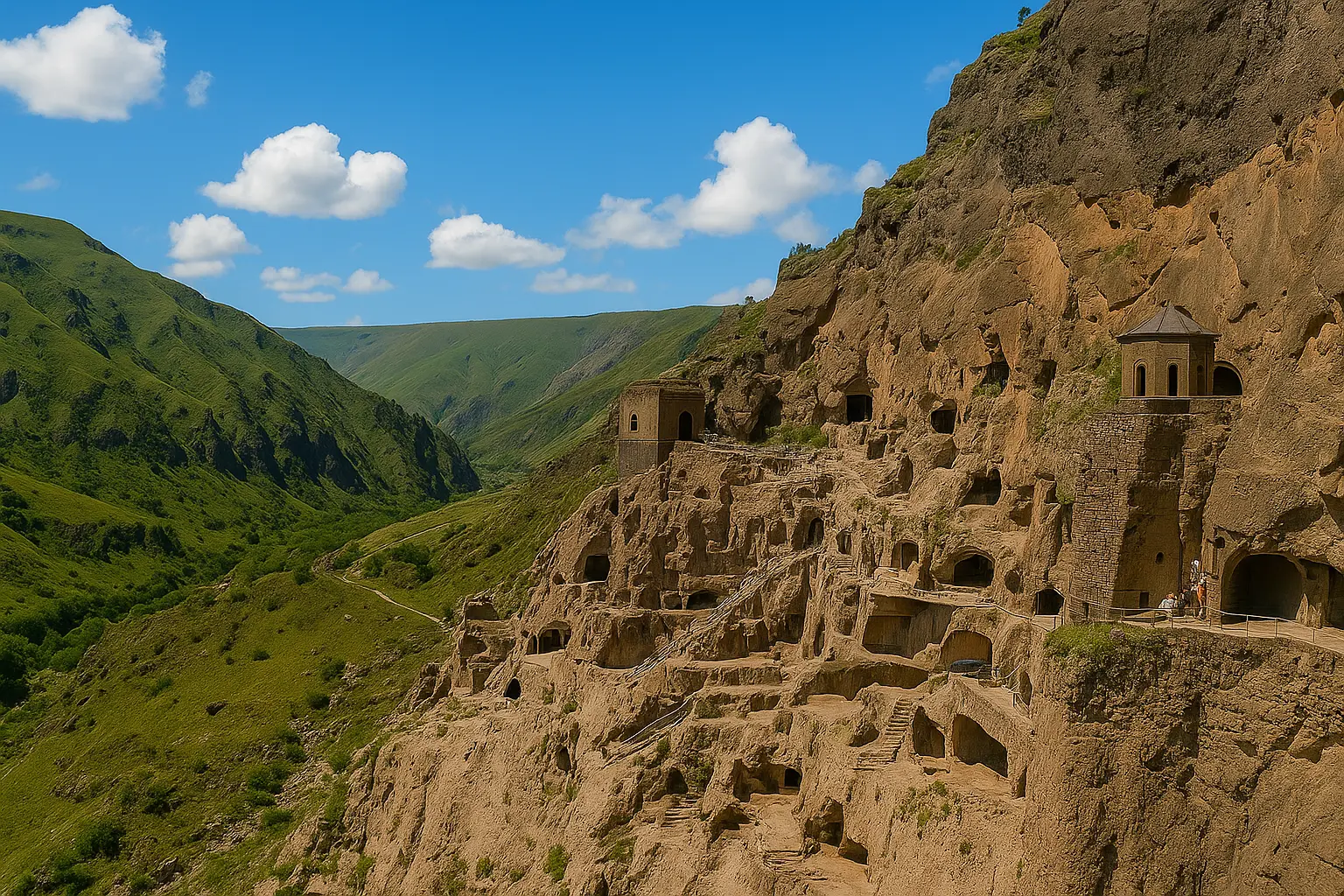
Vardzia, Georgia's most spectacular cave city, stands as a testament to human ingenuity and architectural brilliance, carved into the sheer cliffs of the Erusheti Mountains in southern Georgia. This magnificent complex, constructed during the golden age of Georgian civilization under Queen Tamar in the 12th century, represents one of the most impressive examples of medieval rock-cut architecture in the world. The cave city, which once housed thousands of people and served as a major religious and cultural center, continues to captivate visitors with its dramatic setting, intricate architecture, and rich historical significance.
The construction of Vardzia began in the 12th century as a response to the growing threat of Mongol invasions and the need for a secure refuge for the Georgian royal family and military forces. The site was chosen for its strategic location, perched high on a cliff face that provided natural protection while offering commanding views of the surrounding valleys and approaches. The complex was designed as a self-contained city, with living quarters, religious spaces, storage facilities, and defensive structures all integrated into the natural rock formations.
The architectural complexity of Vardzia is truly remarkable, with the cave city extending over 500 meters along the cliff face and reaching heights of up to 50 meters. The complex originally contained over 6,000 rooms spread across 13 levels, connected by a sophisticated network of tunnels, staircases, and passages. The construction techniques used by medieval Georgian architects demonstrate remarkable engineering skill, with careful attention to structural integrity, ventilation, and water management systems that allowed the city to function effectively for centuries.
The religious significance of Vardzia is reflected in the numerous churches and chapels that are integrated throughout the complex. The main church, dedicated to the Dormition of the Virgin Mary, features elaborate frescoes and architectural details that showcase the artistic achievements of medieval Georgia. The church's interior, with its domed ceiling and ornate decorations, creates a powerful spiritual atmosphere that continues to inspire visitors today. Other religious spaces within the complex include smaller chapels, prayer rooms, and monastic cells that served the spiritual needs of the community.
The daily life of Vardzia's inhabitants can be reconstructed through the various functional spaces that have been preserved within the complex. Living quarters range from simple single-room dwellings to elaborate multi-room apartments that would have housed noble families and important officials. Storage facilities, including wine cellars and grain storage areas, demonstrate the importance of food security and economic activity within the city. Water management systems, including cisterns and channels, show how the inhabitants addressed the challenges of providing water to such a large population in a cliff-side location.
The defensive features of Vardzia are particularly impressive, reflecting the military considerations that influenced the city's design. The complex includes numerous defensive positions, lookout points, and escape routes that would have allowed the inhabitants to defend themselves against attackers. The main entrance to the city was carefully designed to be easily defensible, with narrow passages and strategic bottlenecks that would have made it difficult for enemies to penetrate the complex.
The cultural and artistic achievements of Vardzia are evident in the numerous frescoes, carvings, and architectural details that have been preserved within the complex. The frescoes, which date from the 12th to 14th centuries, depict religious scenes, historical events, and portraits of important figures from Georgian history. These artworks provide valuable insights into the artistic styles, religious beliefs, and cultural values of medieval Georgia, while also demonstrating the high level of artistic skill achieved by Georgian craftsmen.
The decline and abandonment of Vardzia began in the 16th century, following a devastating earthquake that destroyed much of the complex and made it uninhabitable. The earthquake, which occurred in 1283, caused significant structural damage to many of the cave dwellings and made the complex unsafe for continued occupation. Following the earthquake, the remaining inhabitants gradually abandoned the city, and Vardzia fell into disuse and disrepair.
The modern rediscovery and preservation of Vardzia began in the 19th century, when European travelers and scholars began to document and study the complex. Archaeological excavations and restoration work have been ongoing since the early 20th century, with significant efforts to preserve and protect the remaining structures and artworks. Today, Vardzia is recognized as a UNESCO World Heritage site and is one of Georgia's most important cultural and historical attractions.
The visitor experience at Vardzia is truly unforgettable, offering opportunities to explore the ancient cave dwellings, admire the medieval frescoes, and appreciate the architectural achievements of medieval Georgia. Guided tours provide detailed information about the history, architecture, and cultural significance of the complex, while allowing visitors to explore areas that would be difficult to access independently. The dramatic setting of the cave city, with its panoramic views of the surrounding landscape, creates a powerful sense of connection to Georgia's rich historical and cultural heritage.
The conservation challenges facing Vardzia are significant, as the complex continues to be threatened by natural erosion, weathering, and the effects of tourism. The soft rock formations that make up the cliff face are particularly vulnerable to damage from water, wind, and temperature changes, while the increasing number of visitors creates additional challenges for preservation efforts. Conservation work focuses on stabilizing the rock formations, protecting the frescoes from damage, and managing visitor access to minimize impact on the fragile structures.
The cultural and educational value of Vardzia extends far beyond its historical and architectural significance. The complex serves as an important educational resource for understanding medieval Georgian society, architecture, and culture, while also providing opportunities for research and study in various fields including archaeology, art history, and engineering. Educational programs and interpretive materials help visitors understand the complex's significance and appreciate the achievements of medieval Georgian civilization.
The future of Vardzia depends on continued efforts to preserve and protect this unique cultural heritage site while making it accessible to visitors and researchers. Conservation work, visitor management, and educational programs will be essential for ensuring that future generations can continue to experience and learn from this remarkable example of human creativity and engineering skill. The commitment of the Georgian government, international organizations, and local communities to preserving Vardzia will be crucial for its long-term survival and continued cultural significance.